


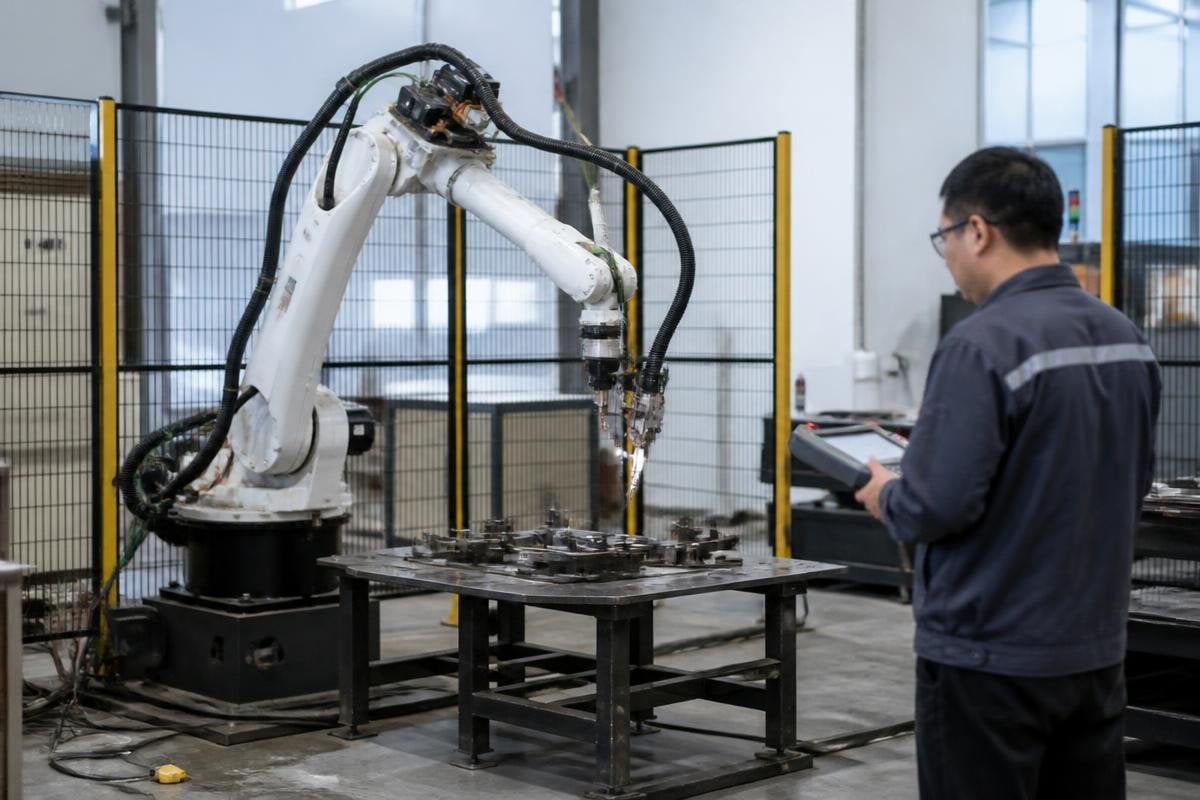
A safety standard can tell a robot maker how to find hazards, stop motion, and record test results. It can’t see the loose cable beside a robot arm, the changed work step, or the tired person who enters the cell after training.
Quick read
- Standards give makers and buyers a shared safety checklist.
- They work best when teams test the robot in the place where it will run.
- A certificate does not replace guarding, training, maintenance, or daily checks.
What a global standard can control
A common standard gives different companies the same basic language for risk. The standard can ask a maker to list possible hazards, set safe limits for motion, check the stop system, and record the result. That makes a safety review easier to inspect and repeat.
The value grows when a robot changes hands. A factory buyer can ask for the same type of evidence from an arm maker, a mobile robot supplier, or a system integrator. Without shared rules, each company may describe safe operation in its own way, leaving the buyer to compare documents that measure different things.
Standards can also shape the design. A robot may need a guarded work area, a reliable emergency stop, limits on speed and force, or a control system that stops motion when a sensor sees a person. These checks give engineers clear work to complete before a machine reaches a production floor.
That matters for automation teams because safety faults often sit between products. The arm may be safe on its own. The gripper, conveyor, camera, software, and access door can create a different system once they work together.
Where the rules stop
A standard describes a safe setup under defined conditions. A site still has to keep those conditions in place. A new gripper can change the arm’s reach. A software update can change motion. A new pallet size can put a person closer to moving parts.
Those changes call for a fresh risk review. The work may include new measurements, updated guards, revised training, and another stop test. A document from the original installation cannot cover changes nobody checked.
People also use machines in ways a design team did not plan. A worker may reach into a cell to clear a jam. A maintenance technician may bypass a door switch during repair.
A supervisor may raise a speed limit to meet a production target. The written rule can forbid each act, but the site still needs controls that make the unsafe path hard to take.
A standard can set limits for speed, stopping distance, and force, but a buyer still needs proof that a named robot met them during a real task. Robot 24 reports can place those test details beside the formal rule, which leads to the next question: what does certification actually prove?
Certification is useful, but it is not the whole answer
A certificate can show that a product or system passed a defined review. It can help a buyer sort suppliers and ask better questions. It can also give an insurer, inspector, or customer a record to check.
The limit sits in the word “defined.” The review covers a stated model, setup, software version, and set of conditions. It may not cover the exact cell you plan to build, the people who will maintain it, or the faults that appear after months of use.
I’d treat certification as an entry check, then judge the full installation on its own evidence.
That evidence should connect to the job. If the robot moves bins near people, check the stopping distance with the real load. If it uses vision, test the camera with the lighting, dust, and blocked views found on the floor. If staff can enter the area, check every access point and every restart sequence.
A buyer’s safety checklist
Use these questions before signing off an automated cell:
- Scope: Which robot, tool, software version, and work area does the review cover?
- Hazards: What can strike, crush, cut, trap, burn, or drop an object?
- Stops: How does motion stop, and what distance does the robot travel before it stops?
- Changes: What event forces a new risk review after installation?
- Evidence: Can the supplier show test records for the loads, speeds, sensors, and guards used in your cell?
A global standard can make those questions easier to ask across borders. It can reduce gaps between suppliers and give safety teams a common record. The hard part remains local: checking the machine after delivery, after changes, and during the work people actually do.
The next useful measure is not how many certificates a robot carries. It is whether the installed system still passes its stop, access, and fault tests after the first production change.
